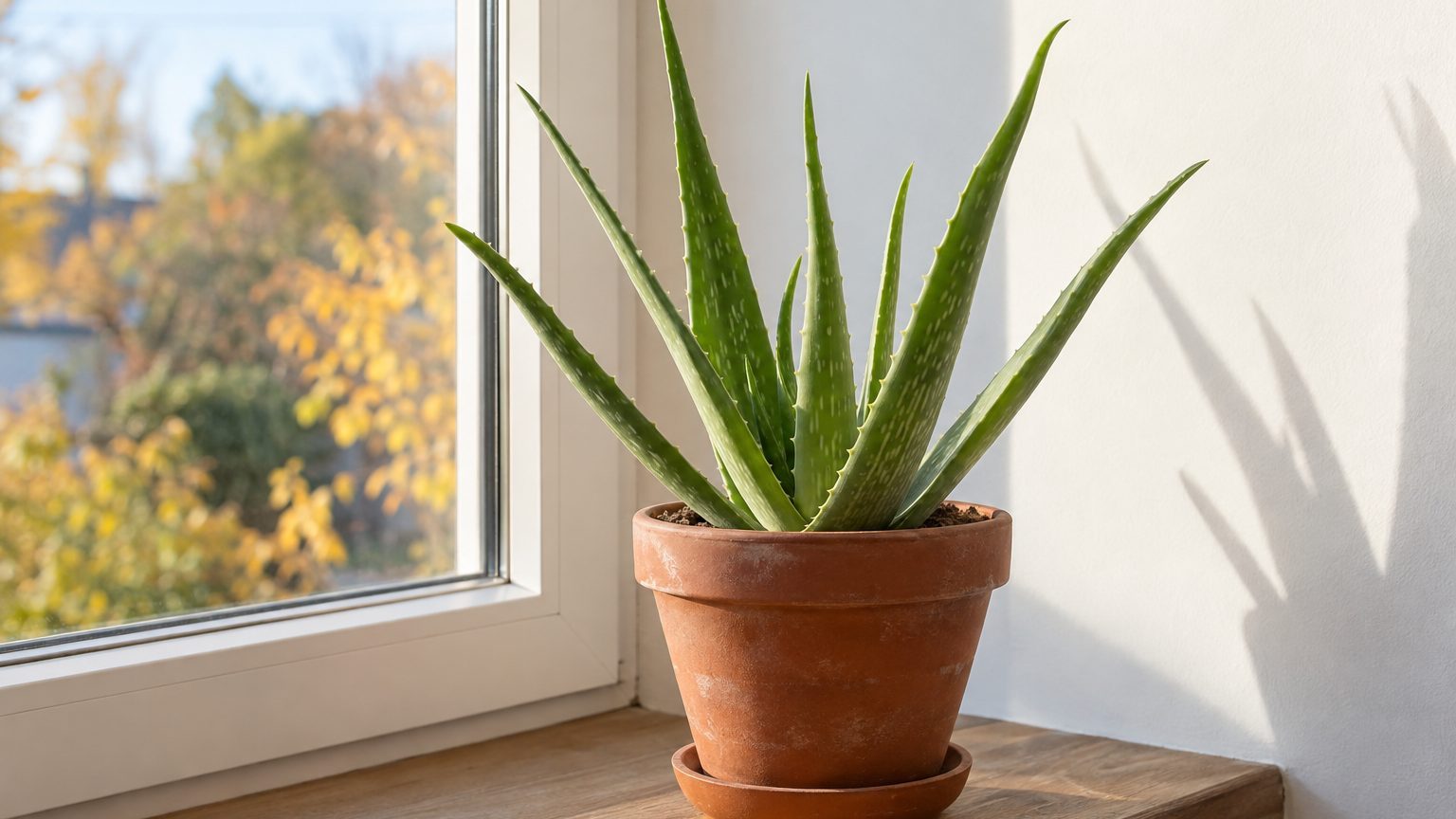
Aloe vera needs three things: strong light, a fast-draining pot, and a long dry spell between drinks. Get those right and the plant will fill out with thick, gel-heavy leaves for years.
Most dead aloes drowned.
The species is native to Africa, Madagascar and the Arabian Peninsula, where it grows in nutrient-poor soil. A thick leaf is a water tank, and the plant is built to coast on it. Like a cat that looks idle on the sofa and is in fact conserving energy, aloe does its best work when left alone.
What Kind of Light Does Aloe Vera Need Indoors?
Bring the brightest spot in the house. Most aloes need at least 6 hours of sun and grow best in full sun or very bright, indirect light. In practice that means a south or west window, or a spot just back from one.
Think of how a cat tracks the sunny patch across the floorboards. Aloe does the same thing, only slower, by leaning its rosette toward the glass. A quarter turn of the pot every week or two keeps it growing evenly instead of lopsided.
Too little light shows up fast. Low light makes the plant leggy, with weak leaves that droop. Too much, too suddenly, causes a different problem, because direct sunlight can burn its tender skin. A plant that spent the winter in a dim corner shouldn’t go straight into a July window, and one summering on a porch should be acclimated gradually to partial sun.
Pale, stretched and leaning means it wants a brighter window.
How Often Should You Water an Aloe Vera Plant?
Less often than feels natural. The method that works is a thorough soak followed by a complete drain: let the soil dry between waterings, then water well and let the excess run out of the pot. In a warm, bright room that often works out to every two to three weeks, but the soil’s dryness should set the schedule, not the calendar.
Check by lifting the pot. A light pot means dry soil, and a heavy one means wait. A wooden skewer pushed to the bottom works too, and so does a finger buried two inches deep.
Watering an aloe on a fixed schedule is like feeding a beagle every time it stares at you. The plant can’t say no, and kindness slowly does the damage. Winter makes it worse, since the plant goes dormant in the cold months, so watering should be reduced. Many growers drop to about once a month, sometimes less in a dim room.
Thirst is easier to fix than drowning. A dry aloe gets yellow, shriveled, puckered leaves, and it should recover once watered again.
What Is the Best Soil Mix for Aloe Vera?
Gritty, loose and a little bit poor. Sandy soil or a pre-mixed cactus potting medium is best. Bagged cactus mix is the easy route, and a handful of extra perlite or pumice makes it drain even faster.

Mixing your own is simple. A common recipe is two parts all-purpose potting soil, two parts coarse sand and one part perlite or pumice. Whatever the blend, it should feel like it falls apart in your hand rather than holding together like brownie batter.
The pot matters as much as the mix. Choose one with several drainage holes, and consider terracotta, since the porous clay wicks moisture out and lets the soil dry faster. Pick a container only slightly wider than the root ball. Oversized pots hold extra wet soil that the roots can’t use.
A pot without drainage holes is a bathtub with no plug.
Aloe also sends up pups, small offshoots at the base. When they crowd the pot, it’s time to repot. Separate the pups and plant each one in its own container of fresh dry mix.
How Do You Harvest Aloe Vera Gel Without Harming the Plant?
Start with the outer leaves, because they are the oldest and plumpest. Cut one close to the base with a clean, sharp knife and leave the center rosette alone, since that’s where new growth emerges. Take only a leaf or two at a time and let the plant rebuild between harvests.
Next comes a step many guides skip. Stand the cut leaf upright in a glass for about ten minutes so the yellow latex drains out. That bitter fluid sits just under the rind, and it is the part that causes trouble. The ASPCA lists aloe as toxic to dogs, cats and horses, with saponins and anthraquinones as the toxic principles.
After draining, trim off the spiny edges and slice away the green rind. Scoop out the clear gel with a spoon and rinse off any trace of yellow. Fresh gel keeps in the refrigerator for several days, and a little on a patch of skin before wider use is a sensible test, since some people react to it.
Households with pets should treat the plant itself as the risk, not just the gel. Set the pot on a high shelf, and do the cutting where a curious nose can’t reach the leaf scraps. If a pet does chew on a leaf, the number to call is ASPCA Poison Control at (888) 426-4435, or your local veterinarian.
Why Are My Aloe Vera Leaves Turning Brown or Mushy?
Mushy almost always means too much water. Root rot comes from overwatering, and the signs are leaves that turn translucent and soft, a squishy base and soil that stays damp for days. Stop watering and slide the plant out of its pot to look at the roots.
Healthy roots are firm and pale. Rotted ones are brown or black and fall apart when touched. Trim away everything soft with clean scissors, let the plant sit out for a day, and repot in fresh dry cactus mix. Hold off on watering for about a week, which gives new roots time to form.
Brown has more than one cause, so the pattern matters. Dry brown patches on the leaves facing the window point to sunburn from sudden strong light. Crispy tips can mean long gaps without water, and a plant that stays soft but brown after a cold night probably got chilled against the glass. Shriveled leaves that are not brown usually just need a drink.
Skip the fertilizer while the plant is struggling. A stressed aloe in wet soil, cold air or low light can’t use the extra nutrients. Fix the light and the watering first, then trim damaged leaves at the base once the plant has stabilized.
For homes where a cat treats every leaf as a chew toy, Haworthia is a lookalike succulent with a similar rosette shape, and the ASPCA lists it as non-toxic to cats and dogs.
Sources: plants.ces.ncsu.edu